
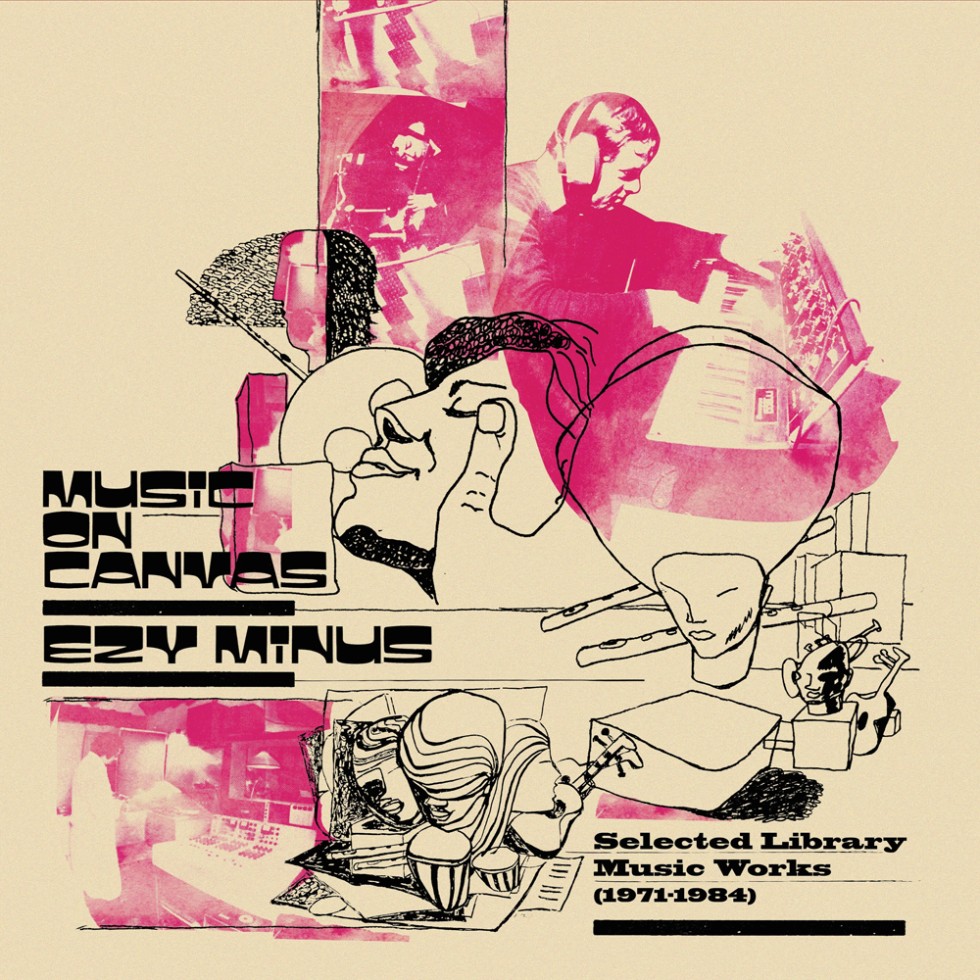
Ezy Minus – Music On Canvas
-
£27.00
While still unknown to many today, Enzo Minuti (1927-2000), aka Ezy
Minus, left his unique mark on the kaleidoscopic world of Italian
library music. One of the most versatile, skilled and authentic figures
in the Bolognese music scene of the mid- to late 20th century, Minuti
was a multi-instrumentalist, composer, music producer and recording
studio manager, as well as a painter, etcher and graphic artist. He
devoted his life to music (especially jazz, a genre that has enjoyed a
long tradition in the city of Bologna), so much so that even his visual
art was inspired by music.
Born in Genoa, Minuti was raised in Bologna, where he obtained a high
school diploma in chemistry. Basically a self-taught musician, he began
to play the button accordion – a traditional instrument of northern
Italian folk music – when quite young, before developing a preference
for jazz and taking up the tenor saxophone, the clarinet and the flute,
which would become his instruments of choice (he could sing and play the
piano, too). After graduating from high school in 1946, he started
performing regularly in local nightclubs and dance halls, which then led
him, in the 50s and early 60s, to leave Bologna and tour Italy, Turkey,
Germany, Scandinavia and Northern Europe as a professional musician for
a number of Italian jazz bands, including a quintet led by Bolognese
guitarist Sergio Mondadori. While on tour with Mondadori, he shared the
stage with the likes of Dizzy Gillespie, Quincy Jones, Dave Brubeck and
Paul Desmond (Turkey, 1954-1958) and even jammed for a few nights in a
row with Elvis Presley (Munich, 1959). Apparently, Minuti and the rest
of the quintet introduced Elvis to two popular Italian songs of the
time, O Sole Mio and Torna A Surriento, which the US star subsequently recorded in English as It’s Now Or Never and Surrender, respectively.
Finally back home in the late 60s, Minuti continued his career as a
professional jazz musician, eventually releasing or featuring in a
number of albums and enjoying particular success as a flutist (his
contemporaries praised him as a ‘poet’ of the flute, and he even got his
own entry in the Dizionario del Jazz published by Curcio in
the late 80s). From 1979 to 1983, Minuti played clarinet and flute in
the Dr. Dixie Jazz Band led by Nando Giardina, which for over 6 decades
brought together the best jazz musicians in Bologna and northern Italy
(including Italian pop legend Lucio Dalla, singer-songwriter Paolo
Conte, and film director Pupi Avati). Over the years, he also performed
with the likes of Pepper Adams, Keith Jarrett, Zbigniew Namoslowsky, and
Franco D’Andrea.
Perhaps most importantly, in the late 60s Minuti opened one of the first
(if not the first) recording studios in Bologna, Studio 67, where he
recorded and/or produced artists from a variety of genres, such as pop,
folk, rock and jazz (Gino Paoli, Francesco Guccini, Fred Bongusto,
Acquaraggia, Dr. Dixie Jazz Band, and others). This is also where,
throughout the 70s and 80s, he composed and recorded his own library
music under the monikers Ezy Minus, Maripal and Cronomas. The fact that
he was based in Bologna is in itself worthy of notice for, at the time,
Italian library music was produced almost exclusively in Rome and Milan
(most of his output in this genre was indeed released by Kronal, a
sub-label of Fabio ‘Fabor’ Borgazzi’s Rome-based Minstrel, and by Music
Scene, a joint imprint of Minstrel and Milan’s Jump Edizioni Musicali).
This collection brings together music composed by Minuti between the
‘70s and the early ‘80s. Within this timeframe, his first library
compositions can be described as cheerful pop-jazz pieces veering
towards either easy listening – with vocal harmonies, jazzy
vocalizations, and rhythmic elements from bossa nova, samba and swing –
or a more psychedelic style, with the use of chromatism and an
experimental rock feel here and there. Later on he also experimented
with genres such as reggae and increasingly used electronic instruments
(synths, drum machines, loop stations, etc.). However, his playful,
light-hearted approach to composition remained unchanged, or was even
enhanced, in his later output (which, like his earlier work, features
simple musical structures, terse arrangements, and delicate and linear
melodies). On a technical note, it is worth mentioning that, not unlike
better-known maestros like Piero Umiliani and Giuliano Sorgini, Minuti
often used the technique of overdubbing and played most instruments on
his tracks (flute, saxophone, organ, piano, percussion), sometimes even
singing some of the vocals.
What is perhaps most striking about Minuti’s library music is its great
imaginative power, the ease and naturalness with which it evokes images
and scenarios in the listener’s mind. This ‘visual quality’ has much to
do with his activity as a figurative and abstract artist. Having
inherited a passion for art from his grandfather and his father (a
professional and an amateur painter, respectively), he taught himself to
draw, paint, etch, and exhibited his works in Italy and abroad. Most
importantly, he also drew the covers of many of his albums. Almost
surrealist in style, these covers are a sort of dreamscapes featuring
symbolic objects, shapes and figures. They go hand in hand with his
evocative, dream-like music, which offers us an immediate, synthetic
representation of an emotion, a situation, or a landscape, and fires up
our imagination with visions at once so simple and clear that they
remain impressed in our memory.
Music and art were inextricably connected in Minuti’s life. Whatever he
saw, heard or laid his hands upon, he had to turn it into song or art.
The title of this collection is a reference to that, and also a way to
pay homage to the many-sided personality of an unsung maestro.
| Format | |
| Format | LP |
| Music | |
| Artist | Ezy Minus |
| Year | 2022 |
| Label | Four Flies Records |
| Tracklisting | A1 – Minus Vocal Group – Situazione (1972) A2 – Minus Vocal Group – Afro Vocal (1973) A3 – Minus Vocal Group – Opening (1972) A4 – Maripal – Tropical Dream (1973) A5 – Minus Vocal Group – Southern Traffic (1973) A6 – Minus Vocal Group – Vocal Blues (1972) A7 – Maripal – The Island of Secrets (1973) B1 – Ezy Minus – Etere (1971) B2 – Ezy Minus – Nuvole che passano (1971) B3 – The Ezy Minus Group – Discoteca (1973) B4 – Los Minus Hernandez – Arapuru (1984) B5 – Minus “Reggae” Group – Savannah Song (1981) |
